Wednesday, October 9, 2013

Lawrence Wells - Kulturní událost / Cultural Event


video walk through of my recent exhibition

drawing on photographs, ink brush drawings, oil paintings and watercolours at Berlinskej model gallery, Prague, Oct 2 2013

http://lwells.tumblr.com/

Wednesday, October 2, 2013

Kulturní událost / Cultural Event - Artist's Statement


Lawrence Wells - Kulturní událost / Cultural Event

paintings and drawings

2/10/2013 19:00

Berlinskej model

Culture, like democracy, is a fragile thing. Like a plant you have to provide it with a place to grow, nourishment and care. But like a plant, culture is often ignored or taken for granted. We forget about it, it’s just there. Like a painting on the wall.

On my trip to Croatia this summer I saw a photo of a cultural event in Rijeka from 1978, people lined up in the street, smiling for the camera. I love old photos of artist groups from various places, all these little regional groups working in parallel, all around the globe. There’s something romantic about it, the urge to create in some little corner of the world. And then I thought about the revolutionary impulse, people taking to the street, how it shares a certain bravery and recklessness with the impulse to make art, to communicate. What has happened to the revolutionary impulse? Did somebody forget to water it?

Last year I was painting about astronauts and indians on the moon. Those paintings were about technology as a dead end, about the empty future, about the end of the world. I needed to get away from that place. Rather than projecting into the future, I turned to the past, which I find is vanishing just as quickly. If you look at old photographs they show worlds gone by. It’s like magic, but also filled with sadness. We can’t get the lost time back. I draw diagrams over the actors from the past, looking for clues in the surface of time. Is there a pattern, some underlying structure that lies hidden in the most mundane corners of existence? Back behind the plants on the shelf or on the window sill where the revolution lies forgotten?

The Vit Soukup retrospective had a big impact on me. His use of photographs as source material, his approach to the banal, his interest in Czech popular culture and the period of normalization. Normalization seems to live on – just as many people have internalised totalitarianism, only understanding power and betrayal in their interpersonal relationships, the cultural stasis in the 80s seems to still be inside us too, we’re stuck in it like a kind of quicksand. Time vanishes, but in other ways it seems to keep returning. We’re trapped in the Eternal Return, like hamsters on a wheel.

The immigrant is the person who stands at a crossroads where different cultures meet; the immigrant becomes a cultural hybrid whose experience falls somewhat to the side of the national cultural dialogue. Immigrants never fully belong to their new home, nor to the one they left. We are like uprooted plants, trying to send a tap root down to find new water. The wind blows us around like dust.

artist's website: http://lwells.tumblr.com/
Berlinskej model: http://berlinskejmodel.cz/

Friday, September 27, 2013

Kulturní událost / Cultural Event


Lawrence Wells - Kulturní událost / Cultural Event
paintings and drawings
2/10/2013 19:00
Berlinskej model
Pplk. Sochora 9
170 00 Prague, Czech Republic
http://www.facebook.com/events/377924192311265/
http://berlinskejmodel.cz/

my work can be seen online here:
http://lwells.tumblr.com/

Friday, September 20, 2013

Potted Plants: Regional Art

I"ve been thinking about regional art currents for awhile, but only recently started to use the internet to do a little detective work.  As an American overseas, my situation makes me more aware of a globalist perspective that most people don't share.  Regional scenes are like potted plants sitting on a shelf, there's very little communication between the regions.  This is especially true in Europe, where language and history keep groups isolated from each other, but in the States its also true that small art scenes have very little contact with each other.  In this day of mass interconnectivity online, its interesting that these kinds of divisions persist.  We are used to classifying culture geographically.


The Regionalists (Thomas Hart Benton, Grant Wood, etc), active pre-WWII, tried to create an Americana style that spoke to the concerns of the common man.  This urge to connect with the working classes is related to the labour movements of the time, and the conservative realist styles the Regionalists used are still found in many regional galleries in the USA.  The common man prefers realism and paintings of subjects and local landscapes that are close to his own experience.  Television and cinema, and now the constant onslaught of imagery in our screen culture, has relegated painting to a forgotten corner of the culture, as if on a dusty shelf in an archive.  The one saving grace seems to be that hand-made objects in a digital age carry a special charge of the unique possession.  Painting and sculpture have always benefited from that power.


Clement Greenberg, in his promotion of the Abstract Expressionists, launched an attack on the Regionalists as backwards and old-fashioned.  Abstract art fit in with the post-WWII rise of the corporation and consensus ideology because it resisted sense of place and referred, as with the works of Jackson Pollock, to deep chaotic spaces which felt current in the age of the space race and mass telecommunications.  One can argue that there are parallels between Abstract Expressionism and Soicialist Realism, as both were essentially officially sanctioned styles on either side of the Iron Curtain which reflected official ideology. The rise of American global empire led to a kind of hegemonic style from the 1950s-80s, although Pop Art can be seen as developing in the UK. After the 1980s, art movements have become less centralized due to the power of mass-media and multiple lines of enquiry have developed a pluralistic approach that also stems from the diminished public interest in the arts.


Everyone is simultaneously a global citizen (despite the absence of any global human rights), and a local inhabitant, but unlike the pre-WWII world where power originated from regional capitals, today power and culture have become global and amorphous.  The attack that Greenberg led on American Regionalism has become global, and local culture feels amateur and less important in comparison to the monolith of global (Hollywood?) culture that creates a spectacle of wealth and violence which dominates the global imagination.  One can say that it has always been thus: Whoever has the biggest megaphone has the greatest voice.  The difference today is that communications is evolving/devolving into a sort of black sea full of competing signals.  In the white noise, temporary autonomous zones (Hakim Bey) come and go, but there is no sense of continuity or development in the cultural dialogue.  Thus culture finds itself in a crisis mirroring the economic and ecological crises.  We seem to be rushing, or rather, stumbling into a paradigm shift of some sort, but for now everything remains in a kind of stasis which is entropic and suffocating.


Ambitious talented artists (like Bob Thompson from Louisville, KY, whose work is pictured here above) have almost always moved closer to the centers of economic power because that is where success is seen to lie.  This infers that the art production in the regions, at the provincial edge, is made by "those who stayed", and also that it is somehow inferior.   The issue I take with this celebrity view of culture is that it discredits the work of the vast majority of artists.  For every De Kooning or Baselitz, there are thousands of regional art professors and local painters and sculptors working in obscurity.  Their work slides below the radar, but is it their fault, or the fault of the "radar"?  If more attention and respect was paid to artists locally, then their efforts would be valued, but we have been conditioned to accept the monolith of global culture, and only a small number of "scenesters" create local culture.  In Europe the traditions of regional culture are stronger, and the tribal identities and language divisions create a more vibrant cultural scene.  In the US, the analogy would be if each state spoke a different language and had a 1000 year old history.  The potted plants of culture may be isolated, but they grow unique cultures which together have made the grand history of art.


On the other hand, the danger of celebrating regional culture is that it can be linked to xenophobia and fear of difference.  Local culture can certainly be rich and unique, but when it suppresses difference, then it is mirroring the same relationship it has with amorphous global culture which eclipses the regional.  The positive side of globalism arises from the cultural hybridity that results from the free movement of people and the cross-pollination of ideas.  Regional culture doesn't have to define itself  in opposition to an outside group, dividing the world into camps, us and them.  It can be a celebration of the local and difference, that recognizes the similarities and difference of other regions as well.  Is that too complicated for most people?


Originally I wanted to make this post as a comparison of the art scenes in two regions:  my home state of Kentucky, and Hungary, but as I don't live in either place, then I can only do detective work on line. Like a blind man touching an elephant, I only feel a small portion of the whole.  When viewed from a distance, the art scene in Kentucky seems to revolve around horses and folk art.  The multiculturalism of the US promotes a broad spectrum of different forms of art, and there is an emphasis on crafts like ceramics and woodcarving, over "higher" forms like painting and sculpture.  Many artists show at art fairs and at framing shop/ gallery spaces. This  collection of photos from Murray State University gives a look at one small corner of Kentucky and the art being made there.  Realism is generally valued in regional art, and we can see an interest here in Renaissance painting and the work of Gregory Gillespie.  Expressionist and Abstract painting is also being done of course, much of it in line with the rise of Casual Abstraction, or reflecting a hybrid mix of folk art and abstraction as in the work of Lawrence Tarpey.


I know less about Hungary, but I recently used an image I found online for a painting from an opening in the regional gallery in Pecs.  Just as a skipped Louisville and concentrated on Murray above, so too with Hungary I look at a small scene as opposed to Budapest.  Realistic painting is also popular in Hungary, but the mood seems more subdued than Kentucky, with surrealistic landscape paintings reflecting on socialist housing blocks and decaying machinery.  As in the Czech Republic, there was a strong influence of Informel and Tactilist abstraction in the 60s, and those approaches can still be felt today.  I would also guess that like CZ, the art scene in Budapest is focused more on conceptual installation work and relational aesthetics, as many young artists in Central Europe are rejecting the traditional media.  But the main thing to understand about cultural life in Hungary today is the chilling effect of the rise of Viktor Orban's government.  This right-wing extremists expect the arts to be highly conservative and only work to glorify the national mythology.  All forms of individual, pluralistic expression are being suppressed as they represent the rights of the individual as opposed to the controlled dialogue of the dictatorial state.  The regional gallery in Pecs has even been closed after 35 years, and arts funding is being slashed across the country, closing theatres and other institutions.  Hungary is in a crisis, but the world tends to look away.  This is allowing fascism to grow again in Europe's back yard.


Building an actual bridge from Kentucky to Hungary is almost as difficult as getting people in such disparate parts of the world to care about each other, or to involve themselves in each other's cultural lives.  The immigrants are the ones who represent that meeting point of different cultures, but their voices are generally marginalized.  The United States is a nation of immigrants, and people of many backgrounds can find commonality there.  This documentary, for example, by Sergei Linkov on the Lebanese artist Saad Ghosen in Cincinnati, Ohio illustrates my point.  On the other hand, Europe, despite its greater levels of culture and history, is still a closed society in many respects.  There has been no civil rights movement in Europe, no Martin Luther King here.  Hungary of course is an extreme example .. I doubt I could find a comparable document like the one on Saad Ghosen about an immigrant artist in Hungary.  This is the ugly side of regionalism, the insular fear of the other, that closes the door to the outside.  Its something we must always guard against.


.

Thursday, September 5, 2013

Cries and Whispers - Two Czech Painters

One advantage of viewing international art through the prism of the Czech scene is the way that the smaller country acts as a microcosm which reflects the greater world around it.  As above so below. Although the art market is in crisis now like everything else, one thing the cost of living in Bohemia allows for is the time to produce art, so the scene is rich and growing quickly.  One way to categorize artists which is often overlooked is the degree of aggression and sensitivity in the work, a kind of polar opposition of the extrovert and the introvert.  Cries and whispers, ie. those who shout from the mountain, and those who speak softly. I'd like to focus on two of my favorite painters in the Czech Republic to illustrate this difference, Vladimír Skrepl (b. 1955) and Zbyněk Sedlecký (b. 1976).


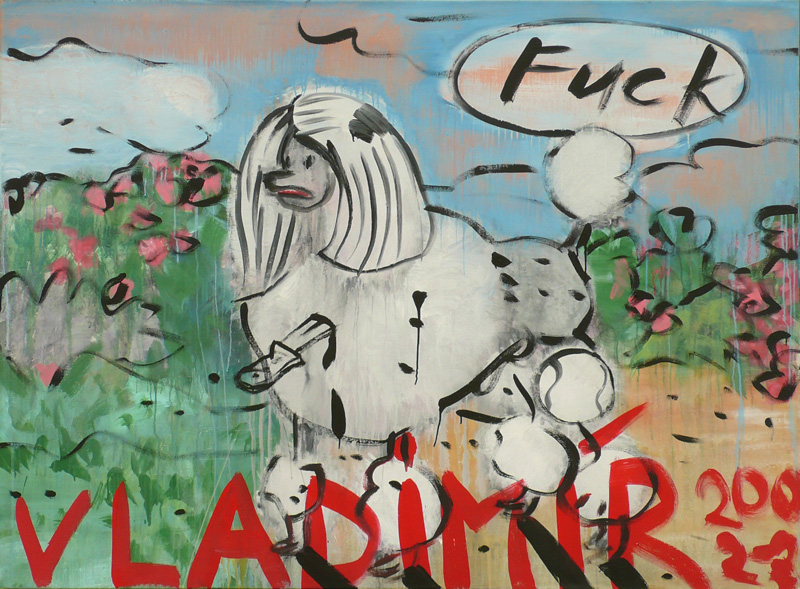
With his wildly expressive mark-making and infantile, regressive figuration, Vladimir Skrepl is the premiere bad boy of Czech art today.  Although his work is suggestive of Baselitz to some degree, Skrepl pushes further into scenes of a humorous nihilistic confrontation, typified by his painting of a poodle stabbed with a knife, the word "FUCK" emblazoned across the surface of the canvas.  Such crass maneuvering can be difficult to carry off, but Skrepl manages to find a sensitive counter-balance, his grotesque figures also elicit our sympathy through their tragic gaze, the sad eyes pull the viewer in.  The paintings reveal a dark ironic humour which hides a tragic, yet honest conception of the world.  Skrepl's confrontational stance reached a climax in the 2007/2008 group exhibit XYXX, which featured Skrepl's large canvases besides wall-sized projections of pornographic video works by Ondřej Brody and Bruce LaBruce.  In the USA this kind of shock tactic would make waves, but over here its just part of the anarchic spirit.


Skrepl soon turned to working more with sculpture, glue-gunning together strange totems from toys, fabric, and other plastic pop culture detritus.  These creatures share the vivid intensity of his paintings, like wayward schizophrenic children spontaneously generating from a garbage mound, there's something unsettling about the sheer number of them.  His most recent show at Galerie Ferdinand Baumann featured plastic brooms suspended from the ceiling, their bristles sprouting strings of ascending strands of glistening pink beads.  His reflections on dust and matter coming alive reveals an alchemical process in which the lowest scum produces treasures beyond measure.  Skrepl revels in this dichotomy.


Zbyněk Sedlecký, just over twenty years younger than Skrepl, works with a much lower confrontational stance, but when studied the paintings reveal a similar intensity of spirit, though more optimistic.  The large-scale acrylic paintings are made up of thin washes applied with the use of stencils and built up in layers.  The quick gestural strokes belie the carefully planned execution, and yet they add to the feeling of an almost effortless calm that permeates the heavy atmospheres of his urban landscapes.   Sedlecký was 13 at the time of the revolution, yet interestingly his work focuses on the decaying brutalist architecture from the 70s and 80s, together with the monumental sculpture that decorated these public spaces, so well documented in the recent Vetřelci a Volavky project.  However, these works do not arise from some misguided Ostalgie, rather they reflect on the present day, a kind of life in the ruins of history.  They resemble photographic snapshots, and like photographs they act as memento morii, faded relics of the passage of time.   Sedlecký's toned-down palette seems to grow from the cloudy gray light in Central Europe that reduces bright tones to an ashen mist.  His paintings are like insistent whispers floating in the air, yet they capture something very specific about the world where they are created.  They capture the current state of being suspended in history between the loss of belief in ideology and the terrible calm before an unclear, yet certainly stormy future.


links:
Skrepl: http://www.ad-astra.cz/umelci/vladimir-skrepl
Sedlecký : http://www.zbyneksedlecky.com/

Tuesday, August 6, 2013

Prague Biennale 6 - highlights

The well-known fact that no one but a small group of people, mostly other artists, go to art exhibitions these days is a pity, but its no reason to despair completely. There are a number of interesting currents in contemporary art and in Prague there's no better place to gauge the creative climate in Europe than the Prague Biennale, now in its 10th year and 6th incarnation.


First there's the location, an isolated old freight train station a few kilometres from the center of town, built in the 1930s. The approach to the exhibition is on a long train platform next to parked flat cars and the empty space around the labyrinthine halls creates a timeless, floating atmosphere. The exhibition is broken into five sections and the first deals with trends in contemporary photography, mostly focused on abstraction and digital technologies. There are a number of compelling works, somewhat humourous in their approach, such as playful compositions combining sliced vegetables with constructivist geometric shapes, and also a large scale photograph of a mysterious puff of yellow smoke hovering in a stairwell. The collage-based sculptural works by Chris Jones(UK) stand out in their use of densely hand-crafted surfaces, small figures from old National Geographic magazines are trapped in a decaying world of rotten fruit, a broken motorcycle, or a shovel left leaning against a wall to rot away into a kind of gelationous photographic goo.


The next section of the show "Expanded Painting" reflects the origins of the Prague Biennale in Flash Art magazine and the Italian scene as it is curated by Giancarlo Politi, the founder of Flash Art, his wife, the art critic and curator Helena Kontova, together with Nicola Trezzi. They pull together a broad selection of artists, both young and old, whose work ranges from rough-hewn geometric abstraction through to neo-surreal pop figuration. The two Romanian artists on display are quite strong, revealing a dynamic cultural scene around the art academy in Cluj-Napoca. The sharp-edge geometric painting and hanging sculpture by Florin Maxa are shown through the projection of an experimental film documenting his 1980 exhibit "The Garden". The jerky frames, shifting focus, anachronistic clothes of the participants, and icicles and tree branches amidst the sculptures create a kind of mystical synthesis that reveals the avant-garde aesthetics of 1980 Romania to be compellingly relevant today. The work of the youger Romanian on display, Mihut Boscu Kafchin, reflects on the future instead, or the future that never was, through a dystopian retro-futuristic sensibility, which contains parallels with the literary worlds of Stanislaw Lem or the Strugatsky brothers. Another artist highlighted in Expanded Painting is the rising American art star Joshua Abelow. Abelow got his start as an assistant for Ross Bleckner and he creates small process-oriented geometric abstractions overlaid with reductive stick-figure figuration. There's an anti-intellectual strain to the work and I was prepared to hate it, but the simplicity was underpinned by a sophisticated approach to colour. The banality and product nature of the work, however, like a hybrid between Keith Haring and Mark Kostabi, remains off-putting.


On the second floor the Biennale loses some momentum with a confusing section highlighting the work of contemporary Slovak artists. The emphasis seems to be on documents of a conceptual relational aesthetics, but the shift in focus from the rest of the Biennale, which is highly visual and tactile in nature, leaves something lost in translation. Then there is a section devoted, oddly enough in a Biennale, to a single individual, the recently deceased outsider Czech artist Miroslav Tichy. The phenomenon of Tichy's rise in the art market has caused somewhat of a stir considering that his relationship with the foundation that promotes his work was quite murky. Although Tichy's biography makes for good copy, I don't think the work holds up, so I skipped over it. The soundtrack of sustained piano chords in this section of the exhibit was soothing though.

The remaining part of the Biennale, called Flow, is a strong showcase of mostly Czech and German work that fits quite well with the Expanded Painting section. Curated by Zuzana Blochová and Patricia Talacko, Flow examines trends in contemporary art practice that build on Central European Modernist approaches, especially in the use of collage and installations. The visionary Czech artist Čestmír Kafka, represented here by a few small sketches from the 1940s, presides over the other artists on exhibit in the principles of an exploratory figuration, touched by melancholia, resting side by side with an unidealised abstraction. A similar approach can be seen in the primitivist collages by Viktorie Valocká and the drawings and womblike figurative reliefs by Quirin Bäumler. A similar strain of symbolist Modernism can be felt in the photo installation "Sun Galaxy with Ape sunbathing" by Erwin Kneihsl and the more abstract "Postobjects" installation by Matyáš Chochola with its homage to Brancusi. (Romania once again!) The Prague Biennale in its mix of both commercialised interests and experimental reconfigurations of Modernist tropes reveals the extent to which Prague remains a crossroads of Europe where numerous cultural currents from both east and west can come together and cross-pollinate.